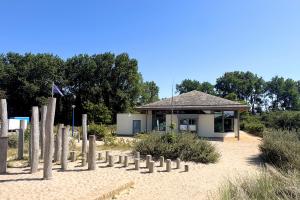
Merovingians in the dunes (7th and 8th centuries)
The oldest traces of settlement in Koksijde go back to the early Middle Ages.
- A Merovingian burial ground: a burial ground from the 7th and 8th centuries with 53 people has been found in Koksijde.
- Two groups: genetic research by Professor Maarten Larmuseau showed that the dead belonged to two groups of different origin, who lived and were buried here together.
- Different diets: according to isotope analysis, some of them ate fish and others did not.
- The name: the name Koksijde may be linked to the cockle, kokkel in Dutch, a shellfish found on the beach.

The Dunes Abbey of Ten Duinen (1107 to 1796)
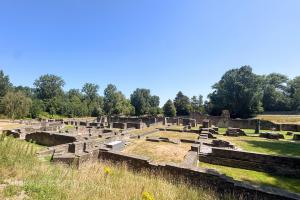
In the dunes of Koksijde, one of the richest abbeys of the Low Countries grew up in the Middle Ages.
- A hermit (1107): around 1107 the hermit Ligerius settled in the dunes, and from 1127 a religious community grew here under Fulco.
- Cistercians (1138): in 1138 the abbey joined the Cistercians under the influence of Bernard of Clairvaux; its motto was Fac necessitate virtutem, make a virtue of necessity.
- Abbot Idesbaldus (1155): in 1155 Idesbaldus became the third abbot; he laid the foundations of the abbey's great estates.
- Ter Doest (1175): in 1175 the abbey of Ter Doest near Lissewege was founded as its only daughter abbey.
- Iconoclasm (1566): in 1566 works of art were destroyed and much of the unique library was lost; from 1578 the monks had to flee.
- Idesbaldus found (1623): while demolishing the old abbey, which was disappearing under drifting sand, a lead coffin with the remains of Idesbaldus was found in 1623.
- The end (1796): the abbey later moved to Bruges and was abolished in 1796.
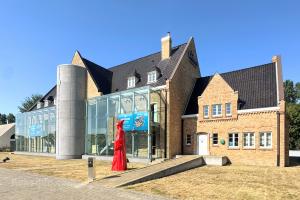
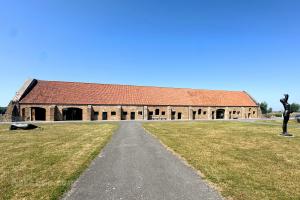
From Cauxyde to seaside resort (1777 to 1945)
After the abbey, Koksijde became a small village again, until the tram brought the seaside resort at the start of the 20th century.
- Cauxyde (1777): on the Ferraris maps of 1777 Koksijde is the tiny hamlet of Cauxyde, with only the church and about ten farms; there was still nothing in the dunes.
- The steam tram (1886): in 1886 Koksijde village became accessible for the first time, when the steam tram between Ostend and Nieuwpoort was extended to Veurne.
- Horse trams: from 1904 to 1909 a horse tram ran between the village and the beach, and from 1910 to 1914 another horse tram ran from De Panne to a hotel in Sint-Idesbald.
- Sint-Idesbald: the resort was first called Zeepanne-Baden and was later named after Abbot Idesbaldus of the Dunes Abbey.
- To De Panne (1914): in 1914 the steam tram from Koksijde-Bad was extended to De Panne and electrified in 1929; this became today's Coastal Tram.
- Lines closed (1941): in 1941 the occupiers closed the line between Veurne and Koksijde-Bad.
Artists, church and nature (1945 to today)
After the Second World War Koksijde became a popular resort and Sint-Idesbald a true artists' village.
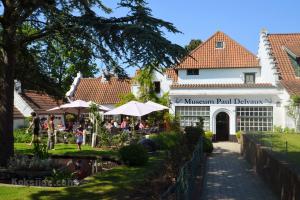
- Latem-on-sea: Sint-Idesbald is sometimes called Latem-aan-zee; residents included the sculptor George Grard and the painter Paul Delvaux.
- The air base: Koksijde air base is home to the search and rescue helicopters of 40 Squadron, known from the series Windkracht 10.
- Merged municipality: the municipality of Koksijde now consists of Koksijde, Oostduinkerke and Wulpen.